

Hi, I’m Becky—the Grandma Who Buys Houses

I help homeowners think through their next steps when life starts to shift—whether that means downsizing, letting go of a well-loved home, or simply trying to make sense of what to do next. I’m not here to rush you—I’m here to help you see your options clearly.
I’ve walked through downsizing myself after decades in our home, and I understand how much more this is than just a real estate decision.
✔ No pressure conversations
✔ Clear options, not one-size-fits-all
✔ A pace that works for you
At some point, many of us look around our home and realize something has changed.
The house that once fit our life perfectly may now feel too large, too demanding, or simply no longer aligned with where we are today. Maybe the kids are grown. Maybe health or mobility has changed. Maybe the desire to be closer to family has taken root. Or maybe it’s just a quiet sense that it’s time.
Downsizing isn’t just a real estate decision—it’s a life transition.
For most people, the hardest part isn’t knowing something needs to change.
It’s figuring out what to do next.
If that’s where you are, you’re not alone.
This is about more than a house
A home holds more than walls and a roof.
It holds memories. Milestones. Seasons of life that are tied to rooms, furniture, and even the smallest items tucked away in drawers and closets.
When you begin to think about downsizing, you’re not just deciding what to do with a property. You’re facing questions like:
- What do I do with everything we’ve accumulated over the years?
- How much work should I put into the house before selling?
- Do I list it, or sell it as-is?
- How long will this process take?
- Am I ready for this change?
Those are real questions—and they deserve thoughtful answers.
What most people are really trying to figure out
When people begin thinking about downsizing, the questions usually aren’t just about the house.
They’re about what comes next—and how to make a decision you won’t regret.
- What should I fix, and what should I leave alone?
- Is it better to sell traditionally or keep things simple?
- How much time, energy, and money should I really put into this?
- What if I make the wrong decision?
Most people don’t need more information.
They need a way to think it through.
The question most people are really asking
Underneath all the details, most homeowners are asking:
“What’s the right way to handle this home at this stage of my life?”
And the honest answer is:
There is no single “best” way.
There is only what fits your life, your timeline, and your peace of mind.
That’s where having a simple framework can help.
Most people find clarity when they can see their options side by side.
Three common ways people approach this decision
🟢 Good — The Bare Minimum
This approach focuses on doing just enough to make the home presentable.
- Deep cleaning
- Addressing safety concerns
- Tidying the exterior
- Listing the home As-Is
This is often the right choice for people who don’t want to take on a large project and prefer to move forward quickly.
🟡 Better — Making the Home Feel Cared For
Here, the goal is to improve the home’s presentation without taking on a full remodel.
- Light repairs
- Paint touch-ups
- Cleaning and decluttering
- Basic updates
This can attract more buyers and improve offers, without the stress of a major renovation.
🔵 Best — Full Remodel
This is the most involved path.
- Updating major systems
- Renovating kitchens and bathrooms
- New flooring, paint, and finishes
It can bring the highest price—but also requires the most time, energy, and coordination.
Before you decide anything, start here
If you’re not sure which path makes sense, I put together a simple guide to help you think it through.
👉 Becky put together a simple guide to help you think through what to fix, what to skip, and when to sell as-is.
If it would help, you can walk through it below at your own pace.
It’s not about choosing the “best” option—it’s about choosing the right one for you.
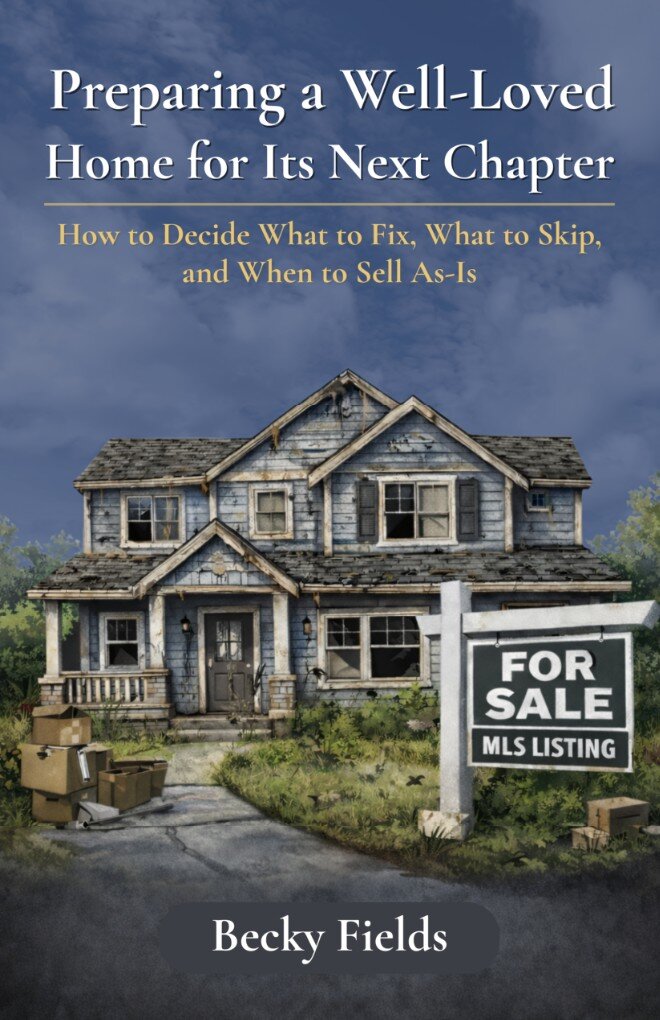
Start with clarity before making a decision
If you’re not sure what to do with the house, this will help you think it through.
✔ See what’s worth fixing—and what’s not
✔ Understand when it makes sense to sell as-is
✔ Make a decision that fits your timeline and situation
Takes about 5 minutes. No pressure, just clarity.
Downsizing is more than choosing how to sell
Once you begin thinking about downsizing, it quickly becomes clear that the house is only one part of the process.
There are several layers to think through—and each one affects the others.

What downsizing looks like for different people
No two downsizing situations look exactly the same.
Here are a few common scenarios that may feel familiar:
Couple in their 70s
They’ve lived in the same home for 30 or 40 years. The house is full of memories, but it’s also becoming harder to maintain. Their goal isn’t to maximize price—it’s to simplify life and be closer to family.
Widow or widower
The home no longer feels the same. It may be too large, too quiet, or too tied to a previous chapter. The decision is not just practical—it’s deeply emotional.
Adult children helping parents
The parents may not be ready to make a move, but the children can see the need. These situations often require patience, respect, and careful communication.
Homeowner ready for a lighter footprint
No major event—just a growing sense that it’s time for something simpler, smaller, and easier to manage.

If you see yourself in any of these, it can help to know that there isn’t a “standard” path. There’s only the one that fits your situation.
What to do with everything
For many people, this is the most overwhelming part of downsizing.
A lifetime of belongings doesn’t always fit neatly into a smaller space. Every item carries some level of meaning, and decisions that seem simple on paper can feel heavy in practice.
You don’t have to figure it all out at once.
Downsizing isn’t a single decision—it’s a series of smaller ones, made over time.
Some things will be easy to let go of.
Some will take longer.
And some need to be handled with care, not speed.
This process takes time—and grace.
Timing the transition
Some people move first and deal with the house later. Others feel they need to sell before making a move.
There’s no single “correct” order.
What matters most is choosing a sequence that fits your situation—your finances, your support system, and how much change you want to take on at once.
For some, that means simplifying life first, then deciding what to do with the house.
For others, it means resolving the house before moving forward.
Either way, you’re not locked into one path.
You’re allowed to take this one step at a time.
Family dynamics
Downsizing often involves more than one person’s opinion.
Adult children, spouses, or extended family may all have perspectives—and sometimes expectations—about what should happen.
And even when everyone means well, it doesn’t always feel simple.
There can be different priorities. Different timelines. Different ideas about what’s “best.”
That can create pressure—especially when you’re the one living in the home and facing the decision.
Clear, honest communication helps.
But just as important is remembering whose decision this ultimately is.
Emotional readiness
Even when downsizing makes practical sense, it doesn’t always feel easy.
Letting go of a home can feel like closing a chapter of life.
There are memories in the walls. Seasons of life tied to rooms, routines, and the people who filled them.
That’s not something you rush past.
It’s something you acknowledge—and move through at your own pace.
Financial considerations
Every option—whether listing, updating, or selling as-is—comes with trade-offs.
Some choices take more time.
Some require more money upfront.
Some bring more uncertainty along the way.
And sometimes the “highest price” doesn’t end up being the best outcome for your situation.
Understanding those trade-offs clearly helps you make a decision you can feel at peace with later.
The different paths people take
There are a few common ways people move through this stage of life.
You may recognize one of these:
• Moving into a smaller home first, then selling the current one
• Selling the house as-is to keep things simple
• Making updates and listing it on the market
• Keeping the home as a rental
• Passing the home along within the family
None of these is “right” or “wrong.”
Each one simply fits a different situation, timeline, and set of priorities.
The key is making the choice on purpose—so you can move forward with clarity, not second-guessing.
🟪 🔥 CTA #2 (SECOND INVITATION)
👉 After “paths people take”
Title:
Not sure which path fits your situation?
Text:
This short guide walks through what to fix, what to skip, and when selling as-is might make sense—so you can think it through clearly.
Button:
See What to Fix, What to Skip, and When to Sell As-Is
[13a] How to decide what’s right for you
If you’re feeling stuck, it often helps to walk through a few simple questions:
What matters most right now?
Is your priority speed, simplicity, financial return, or reducing stress?
How much time and energy do you want to invest?
Some options require months of effort. Others allow you to move forward quickly.
What role does your family play in the decision?
Are others involved? Do they need to be part of the process?
Are you making this decision from pressure or clarity?
Urgency can push decisions—but clarity leads to better outcomes.
You don’t have to answer everything at once. But working through these questions can bring a surprising amount of peace to the process.
[13b] What the downsizing process usually looks like
While every situation is different, many downsizing journeys follow a similar rhythm:
Phase 1: Realization
You begin to feel that something needs to change.
Phase 2: Exploration
You gather information, talk with family, and begin to understand your options.
Phase 3: Decision
You choose a direction—sell, keep, move first, or prepare the home.
Phase 4: Preparation
Sorting belongings, handling repairs (if any), and getting ready for the next step.
Phase 5: Transition
Moving, selling, and settling into the next chapter.
Knowing these phases can help you recognize where you are—and what comes next.
[14] When selling may make sense
For many homeowners, selling becomes the right step when:
- The home feels like more responsibility than benefit
- Maintenance or repairs are becoming burdensome
- The cost of holding the property is increasing
- The desire for simplicity outweighs the desire for top dollar
In these cases, the goal often shifts from maximizing price to minimizing stress.
[15] When it might make sense to hold onto the home
There are also situations where keeping the home can make sense:
- Strong financial position with no urgency
- Desire to keep the home in the family
- Potential long-term rental value
- Emotional attachment that outweighs practical concerns
Again, there’s no universal answer—only the right answer for you.
[15a] Common downsizing mistakes (and how to avoid them)
Over the years, I’ve seen a few patterns that can make this process harder than it needs to be:
Trying to do too much
Taking on a full remodel when it’s not necessary can lead to stress, delays, and unexpected costs.
Waiting too long
Sometimes the decision becomes harder over time, not easier.
Underestimating the effort
Sorting through belongings and preparing a home takes more time and energy than most people expect.
Letting family miscommunication create tension
Clear, early conversations can prevent misunderstandings later.
Assuming there is only one “right” way
There isn’t. The best path is the one that fits your life—not someone else’s.
Avoiding these pitfalls doesn’t make the process easy—but it can make it much smoother.
🟪 🔶 BREAK #3 (IMPORTANT)
Before GTH section
👉 This resets emotional state
[16] Once you’ve decided… the next step is often the hardest
Making a decision is one thing.
Walking through the process is another.
This is where many people feel stuck—not because they don’t know what to do, but because they don’t know how to move forward step by step.
[17] A guide for walking through the transition
That’s why I created Guiding Them Home.
If the downsizing guide helps you decide what to do,
this resource helps you walk through how to do it.
It addresses:
- Sorting through belongings
- Planning the move
- Handling timelines
- Navigating family involvement
- Reducing stress during the process
It’s not about selling a house.
It’s about moving through a life transition with clarity and confidence.
[17a] What most people wish they knew earlier ⭐ OPTIONAL BUT STRONG
Looking back, many people say the same things:
- “I wish I had started sooner.”
- “I wish I had asked for help earlier.”
- “I didn’t realize how emotional it would be.”
- “I thought it would be more complicated than it actually was.”
Sometimes the hardest part is simply beginning.
🟪 🔥 CTA #3 (DIFFERENT TYPE)
👉 Not booklet—process
Add:
Button:
See how to walk through the process
[18] Why I approach this differently
I didn’t come into this from a purely real estate background.
I’ve lived this.
I’ve raised seven children. I’ve helped care for parents in our home. I’ve walked through seasons of loss, transition, and change alongside family.
And more recently, my husband and I downsized our own home after decades of building a life there.
I understand what it feels like to stand in a room full of memories and wonder what comes next.
That’s why my goal is not to push you toward a decision.
It’s to help you find the right path for your situation—and walk it with confidence.
[19] What others have experienced
(Insert testimonials here — short, simple, human)
🟪 🔥 CTA #4 (FINAL)
👉 This is your main conversion
Structure:
Title:
If you want to talk it through
Buttons:
- Talk with Becky
- See your options
[20] If you’d like to talk it through
Sometimes it helps to have a conversation with someone who understands both the practical and emotional sides of this process.
If that would be helpful for you, I’m here.
No pressure. No obligation.
Just a conversation to help you think clearly about your next step.
👉 Talk with Becky
👉 See your options
[21] Common questions about downsizing
Do I need to fix up my house before selling?
Not always. It depends on your goals, timeline, and the condition of the home.
How long does downsizing usually take?
It varies widely. Some people move quickly. Others take months to work through belongings and decisions.
What if the house needs repairs?
You can still sell it. The question is whether you want to handle those repairs yourself or choose a simpler path.
Is selling as-is a good option?
For many people, yes—especially if the goal is to reduce stress and move forward quickly.
What should I do first?
Start by understanding your options clearly. That’s why the downsizing guide can be helpful—it gives you a place to begin.
[22] A final thought
There is no perfect way to do this.
There is only the way that brings you the most clarity, the most peace, and the best fit for your life right now.
Your home has served its purpose well.
Now it’s simply time to decide what comes next.
You don’t have to figure this out alone—we’ll walk through your options with you.
👉 Start with Becky’s Downsizing Guide
👉 Or talk it through when you’re ready