
If you’ve been thinking about downsizing, you’ve probably already considered the practical side. You can find more on that here. But if you’re like most people I talk to, the house was never really the hard part. The hard part is everything inside it.
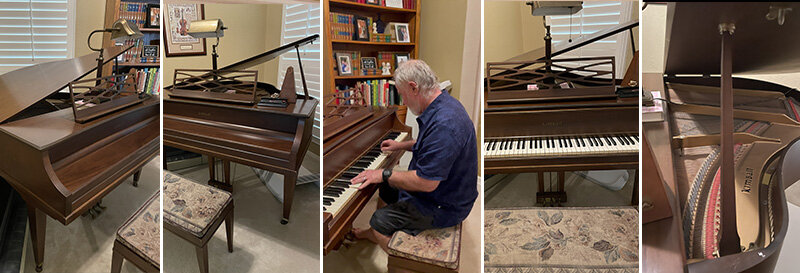
I understand that better than most. My husband and I were married for forty-five years. We lived in the same house for twenty-two of them. Seven kids grew up under that roof, and each left their own mark. When it came time for us to leave, I thought leaving those walls behind would be the hardest part. It wasn’t. The difficult part was the baby grand piano.
Video Transcript
When people think about downsizing, they think about the house… the square footage, the stairs, the yard. But that’s not usually what stops people. What stops people is everything inside it.
There’s a moment… it’s not dramatic… you just notice you haven’t been in a room in months. The kids grew up and left, or somebody passed, or your knees just don’t want to climb those stairs anymore.
The house didn’t change. You did. And once you notice that, you can’t really un-notice it. That’s not a failure. That’s just a season changing.
Here’s what I didn’t expect when I downsized… the paperwork wasn’t the hard part. The packing wasn’t the hard part.
The hard part was the piano. Forty-five years of marriage, twenty-two years in that house, seven kids who all learned on that piano, one of them especially well… I could still hear Mozart, Bach and Handel just glancing at it in my empty living room.
When people ask me where to even start, I understand why it feels impossible. You’re not sorting a room. You’re sorting forty years.
So I tell them… don’t look at the whole house. Look at one drawer. One box. Ask three questions: does this hold a real memory? Will someone use it? Or is it just occupying Space?
I know it can feel like everyone’s waiting on you… family, maybe a realtor, maybe just your own sense that you should have this handled by now.
But the truth is, the house isn’t going anywhere today. And neither is what’s inside it. There’s no deadline here except the one people put in their own heads.
Eventually, I found a family for that piano… a little girl just starting lessons. And that made it easier, knowing it was going somewhere it’d still be loved.
That’s really what this whole process is. It’s not about just getting rid of things. It’s about finding the next home for those things… same as your finding your next home.
If you’re trying to figure out where to start with your own house, I put together something called Guiding Them Home. It’s just the framework I wish I had.
The House Doesn’t Change. You Do.
There’s a moment that happens to almost everyone, and it’s rarely dramatic. You walk past a room you haven’t really used in months, and something quietly shifts. Maybe the kids grew up and moved out. Maybe you lost someone. Maybe it’s simpler than that — your knees just don’t want three flights of stairs anymore.
The house is the same house it’s always been. You’re the one who’s changed. And once you notice that, it’s hard to un-notice it.
That moment doesn’t mean you’ve failed at anything. It just means a season has ended and a new one is starting. Most people I talk to feel a little guilty admitting this, as if wanting something different means they’re ungrateful for what they built. They’re not. Homes are meant to serve the life you’re living. When life changes, it’s allowed to serve you differently, too.
The Part Nobody Warns You About
People expect downsizing to be a logistics problem. Boxes, movers, paperwork. What actually stops people in their tracks is the sheer weight of decades of belongings — and the quiet embarrassment that comes with it. So many people tell me some version of the same thing: I haven’t told anyone yet, but just looking at it all makes me feel like I should already have this handled.
Here’s the truth. Forty years of living doesn’t sort itself out in a weekend. It was never supposed to. Nobody clears a whole life that quickly. Feeling behind doesn’t mean you are behind. It usually just means there was a lot of life packed into those boxes.
I felt this myself with the piano. My kids all learned to play on it, badly, most of them, and I could still hear it standing there in the empty living room long after the house had emptied out around it. I didn’t sell it right away. I let myself sit with it for a while, because there was no reason to rush that decision any more than any other.
Eventually, I found a family with a little girl just starting lessons. Knowing it was going somewhere it would still be loved made it easier to finally let go. That’s really what this whole process is, if I’m honest. It’s not about getting rid of things. It’s about finding the next home for them, just as you’re finding your own.
Why It Feels Like an Impossible Choice
A lot of the stuck feeling comes from an assumption that isn’t actually true — that you only have two options. Keep everything, or get rid of it all at once. Neither one is real. Almost everything in a lived-in house falls somewhere in the middle, and that middle ground is where the actual decisions happen.
When something feels hard to sort, I ask myself three simple questions. Does this hold a real memory, or am I just used to having it around? Will someone else genuinely use it? Or is it just occupying space?
Sometimes the answer comes quickly. Sometimes you’ll sit there holding something for ten minutes before you know. Both are completely fine. There’s no wrong amount of time to spend deciding what something means to you.
There Is No Deadline Here
Somewhere along the way, this decision can start to feel like it needs to happen all at once — today, this week, before someone else weighs in with an opinion. I want to be honest with you about where that pressure usually comes from. It’s rarely the house itself. It’s everyone and everything around it — family timelines, other people’s schedules, your own sense that you should already be further along.
You’re allowed to separate those two things. The house isn’t going anywhere today, and neither is what’s inside it. Whatever pace you’re moving at right now is the right pace for you.
If the whole house feels impossible to think about, don’t think about it. Think about one drawer. One closet. One box. That’s the only decision actually in front of you at any given moment, and it’s enough.
Starting Small, When You’re Ready

I wrote my Downsizing Guide because I needed exactly this kind of simple starting point myself, something small enough to actually begin with when the whole idea of the house felt too big to hold in one hand. If you’re trying to figure out where to start, it walks through this in plain language, the same way I’d talk you through it if we were sitting across from each other.
You don’t have to solve the whole house today. You don’t even have to solve it this month. Just take the next small step when you’re actually ready, and trust that it’s enough. That’s not a lesser way to move through this. It’s simply the way that actually works, one drawer, one box, one decision at a time.
To ready our general downsizing article, click here. If you’re ready to think through what comes next for your own home, at your own pace, you can start here.


FP_07_Downsizing
X_BLOGGROUP_0